

US crypto regulations in 2026: the complete map
- Federal market oversight: split SEC/CFTC, joint interpretation classifies 16 assets as digital commodities — verified Jul 25, 2026
- Stablecoin law: GENIUS Act in force since July 2025, implementing rules past deadline — verified Jul 25, 2026
- Market structure: CLARITY Act pending Senate floor action — verified Jul 25, 2026
- Added Recent Updates entry for New York v. Kalshi lawsuit (Jul 31 filing); prediction markets hub page now current — verified Jul 25, 2026
- Taxation: digital assets taxed as property, broker reporting phasing in — verified Jul 25, 2026


The United States regulates crypto the way it regulates most finance: through overlapping agencies, layered statutes, and a federal-state split that produces different answers depending on where you stand and what you hold. As of September 2026, the system is in its most consequential month in years, with settled components, a stablecoin law, a commodity classification for major assets, normalized banking access, and one enormous open question on the Senate floor. This page maps the whole structure, links to our detailed coverage of each piece, and is maintained as the law moves.
Recent updates
- Sept. 3, 2026: CNBC reports the CLARITY Act is “hanging by a thread.” Multiple Senate offices now expect the bill to fail its Sept. 15 cloture vote, which would effectively kill market-structure legislation for the remainder of the 119th Congress and leave the SEC-CFTC joint classification as revocable agency policy indefinitely.
- Sept. 2, 2026: The SEC announced a Sept. 17 roundtable on 24-hour equity trading with BlackRock, Nasdaq, NYSE, Robinhood, Citadel, and Jane Street. The crypto industry built 24/7 markets a decade ago. Traditional finance is now asking whether to copy the model, and the SEC is facilitating the conversation.
- Sept. 1, 2026: CFTC Chairman Selig has now proposed eight rulemaking items since June, doubling the agency’s output from the rest of the term. New proposals include prediction market rules and a crackdown on war-related event contracts, signaling the agency intends to build its digital-asset jurisdiction with or without Congress.
- Sept. 1, 2026: Twenty-one major banks including Bank of America, Citi, Goldman Sachs, Deutsche Bank, and UBS committed to a joint USD stablecoin company targeting an H1 2027 launch. The consortium represents the largest coordinated bank entry into stablecoins and positions bank-issued tokens as a direct competitor to Circle’s USDC and Tether’s USDT.
- Aug. 29, 2026: The Senate will not vote on the CLARITY Act before its August recess. Majority Leader Thune filed cloture on the motion to proceed on Aug. 8 during an overnight session, setting the procedural vote for Sept. 15 at 2:15 p.m., the day after the Senate returns. The calendar offers only 14 working days before an October election recess and 22 days total through the end of the year.
- Aug. 29, 2026: Federal regulators missed the GENIUS Act’s one-year deadline for final stablecoin rules (July 18, 2026). The OCC targets November 2026 for final rules. The statute’s fallback activation date is now Jan. 18, 2027 (18 months after signing), and issuers continue operating under interim guidance until then.
- Aug. 19, 2026: The SEC proposed Regulation Crypto Assets, its first bespoke offering framework, with a startup exemption (up to $5M), a fundraising exemption (up to $75M), and a safe harbor letting tokens shed security status. 60 day comment period open.
- Aug. 17-20, 2026: Bitcoin spot ETF inflows hit $1.6 billion over four consecutive days, pushing cumulative net inflows to $53.9 billion and total net assets to $83.3 billion.
- Aug. 21, 2026: CFTC Chairman Selig announced the agency will propose its own digital-asset market-structure rules if the CLARITY Act stalls in September.
- Aug. 21, 2026: CME and Kalshi executives clashed at a CFTC roundtable over prediction market regulation, highlighting the jurisdictional fight between incumbent and startup exchanges.
- Aug. 20, 2026: President Trump publicly urged the Senate to pass the CLARITY Act. An ethics clause restricting elected officials from launching tokens has emerged as the provision most likely to block the bill.
- Aug. 2026: IRS Form 1099-DA cost-basis reporting is actively phasing in for the 2026 tax year.
Who regulates what: the federal map
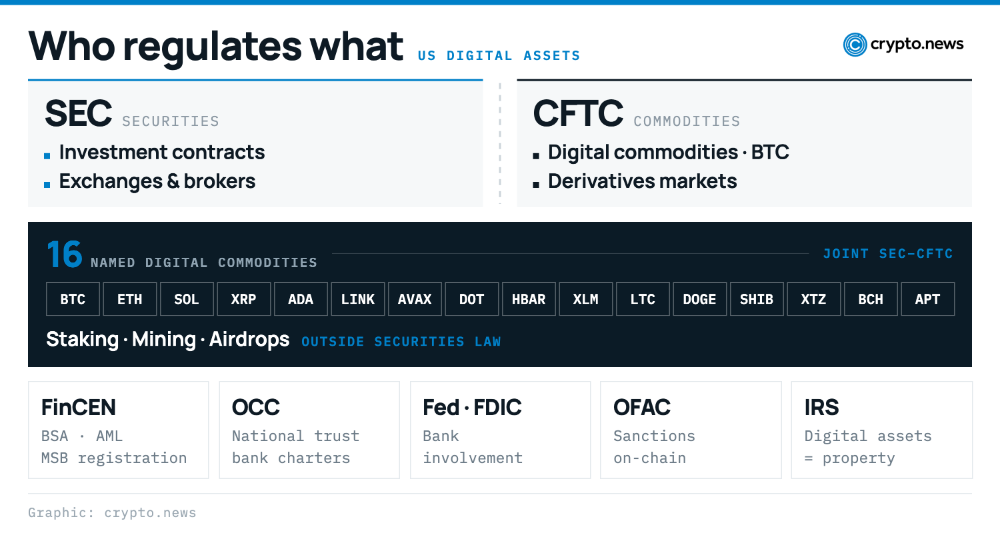
Market oversight divides along the securities-commodities line. The Securities and Exchange Commission regulates digital assets offered or sold as investment contracts, along with the exchanges and intermediaries that handle them; its current posture, detailed on our SEC enforcement page, has shifted from the registration-focused enforcement of the early 2020s toward fraud-focused actions under an interim framework its own leadership describes as a bridge to legislation. The Commodity Futures Trading Commission oversees digital commodities, including Bitcoin, and regulated derivatives markets built on them. The two agencies’ joint interpretation, issued this spring, names 16 digital assets, XRP, SOL, and DOGE among them, as digital commodities and places staking, mining, and airdrops outside securities law, functioning as the operating classification while Congress decides whether to make it statute.
Around the market regulators sit the functional ones: FinCEN administers the Bank Secrecy Act, making exchanges and custodial services money services businesses with registration and anti-money-laundering duties; the OCC charters and supervises national trust banks, a route into the banking system that Circle completed in July and other applicants are pursuing under conditional approvals; the Federal Reserve and FDIC govern bank involvement; OFAC applies sanctions law to blockchain activity; and the IRS, covered on our tax page, treats digital assets as property.
The statutes: one passed, one pending
The GENIUS Act, signed in July 2025, is the first comprehensive federal digital-asset statute. It creates a licensing regime for payment stablecoin issuers, reserve, disclosure, and redemption requirements, and a framework dividing oversight between federal and qualifying state regulators. Its first year is a case study in the gap between passage and operation: the agencies responsible for its implementing rules missed the statute’s one-year deadline on July 18, 2026, leaving every major rule package at the proposal stage. The OCC targets November 2026 for final stablecoin rules, which would push the effective date to approximately March 2027 under the 120 day implementation window. However, the statute includes a fallback activation date of January 18, 2027 (18 months after signing), meaning the statutory framework takes effect on that date regardless of whether regulators have finished writing rules. Issuers continue operating under interim guidance until then. Our GENIUS Act page tracks the rulemaking status in detail.
Banking, states, and taxes: the other three layers
Banking access, crypto’s oldest chokepoint, has substantially normalized: national trust charters now anchor stablecoin issuers, spot Bitcoin and Ethereum ETFs trade on national exchanges alongside newer single-asset and multi-asset products under generic listing standards, and major custodians including BNY Mellon hold reserves for regulated stablecoins. The state layer remains the compliance maze the pending federal bill would partially preempt: New York’s BitLicense sets the strictest bar, most states apply money-transmitter licensing, and a friendly cohort, Wyoming’s special-purpose depository institutions, Texas’s mining posture, competes for the industry; our legality page maps the practical differences. And the tax layer applies regardless of everything above: every disposal of a digital asset is a taxable event under IRS property treatment, with broker reporting on Form 1099-DA now phasing in, detailed on our IRS page.
What changes next
Five trackable events will redraw parts of this map within weeks, not months. The Senate’s CLARITY Act cloture vote is Sept. 15 at 2:15 p.m., the day after the chamber returns from recess. As of early September, multiple Senate offices tell reporters the bill is unlikely to clear the 60-vote threshold. An ethics clause restricting elected officials from launching tokens, disagreements over DeFi treatment, and stablecoin yield provisions remain unresolved. If cloture fails, the bill is effectively dead for the 119th Congress. The SEC-CFTC joint classification stays as revocable agency policy rather than statute, and both agencies have already signaled they will write permanent rules on their own. Our CLARITY Act page tracks every open provision.
The SEC’s Sept. 17 roundtable on 24-hour equity trading is a separate but convergent track. Panels with BlackRock, Nasdaq, NYSE, Robinhood, Citadel, Jane Street, and FINRA will evaluate whether traditional stock exchanges should move to round-the-clock operations, the model crypto markets have run for over a decade. If the SEC moves forward, the structural gap between crypto and traditional markets narrows further.
CFTC Chairman Selig is not waiting for Congress. Eight proposed rulemakings since June, double the agency’s prior output, include prediction market rules, war-related contract restrictions, and a digital-asset market-structure framework the Chairman has said he will finalize independently if the CLARITY Act stalls. The 21-bank stablecoin consortium announced Sept. 1, with Bank of America, Citi, Goldman Sachs, Deutsche Bank, and UBS among its members, targets an H1 2027 launch and represents the biggest institutional bet yet that bank-issued stablecoins will compete directly with crypto-native issuers. And the GENIUS Act rulemakings and OCC charter cohort, including new entrants OpenReserve Bank and Revolut, continue to shape how the stablecoin statute and banking access operate in practice. Each has dedicated coverage linked above, and this page is revised as events land.
Recent Updates
- Sept. 4, 2026: Updated all hub pages with September 2026 developments (CLARITY Act outlook, SEC 24-hour trading roundtable, CFTC rulemaking acceleration, 21-bank stablecoin consortium, new OCC approvals)
- Aug. 21, 2026: Updated SEC, ETFs, and main hub pages with August 2026 developments
- Aug. 11, 2026: Added Banking Access hub page
- Aug. 4, 2026: Added ETFs hub page
Legal Disclaimer: This content is for informational purposes only and does not constitute legal or investment advice. Laws and regulations change frequently; verify current status with primary sources.
Pending: the CLARITY Act. The Digital Asset Market Clarity Act, passed by the House 294-134 in July 2025, would settle the questions the joint interpretation currently answers provisionally: statutory classification of digital commodities versus securities (including a grandfather clause instantly classifying ETP-anchored tokens), allocation of jurisdiction between the SEC and CFTC, registration regimes for exchanges and brokers, a shield for non-custodial software developers, and federal preemption of conflicting state regimes. As of this writing, the bill is on the Senate calendar with updated text released July 22, an ethics provision at the center of negotiations, and a cloture decision expected within days; roughly seven Democratic votes decide the outcome. Our full coverage: what is in the merged text, the ethics provision, and what implementation actually looks like if it passes. This section will be updated when the Senate acts.
Latest Regulation Coverage





Recent Updates
- Aug 21, 2026: Updated SEC, ETFs, and main hub pages with August 2026 developments
- Aug 11, 2026: Added Banking Access hub page
- Aug 4, 2026: Added ETFs hub page
Legal Disclaimer: This content is for informational purposes only and does not constitute legal or investment advice. Laws and regulations change frequently; verify current status with primary sources.
Frequently Asked Questions
Is cryptocurrency legal in the United States?
Yes. Buying, holding, and trading digital assets is legal nationwide, with regulation applying to the businesses that provide access, exchanges, brokers, custodians, and issuers, rather than to ownership itself. Specific activities require licenses, state rules vary, and our dedicated legality page covers the details.
Which agency regulates crypto, the SEC or the CFTC?
Both, divided by asset type: the SEC governs digital assets that are securities and the CFTC governs digital commodities, with a joint interpretation currently classifying 16 major assets, including Bitcoin-adjacent and payment tokens, as commodities. The pending CLARITY Act would write this division into statute.
What is the most important pending crypto law?
The CLARITY Act, the market-structure bill deciding asset classification, agency jurisdiction, and exchange registration. It passed the House in July 2025 and faces its decisive Senate votes before the August 2026 recess, with the outcome determining whether current agency classifications become permanent law.
Do I owe taxes on crypto in the US?
Generally yes, on disposals: the IRS treats digital assets as property, so selling, swapping, or spending them triggers capital gains or losses, and rewards from mining or staking are ordinary income. Broker reporting to the IRS is now phasing in. See our IRS crypto tax guide for the full breakdown.