

XRP holds $1.30 support as exchange reserves plunge — Is a supply crunch forming?


XRP price is holding near a critical support level as exchange reserves fall sharply, a development that could tighten available supply in the market.
- XRP trades near $1.38 while defending the $1.30 support zone after a month-long decline.
- Binance XRP reserves dropped from over $10B in 2025 to about $3.9B, reducing potential selling supply.
- Technical indicators show consolidation, with $1.42 acting as the key level for a possible recovery.
XRP (XRP) was trading at $1.38 at press time, down 3.1% over the past 24 hours. The token moved within a weekly range of $1.28 to $1.46 and has lost about 17% over the past month.
It now sits more than 60% below its July 2025 all-time high of $3.65. Market activity has also cooled.
Trading volume dropped to $2.28 billion in the last 24 hours, down 38% from the previous day. Data from CoinGlass shows derivatives volume fell 26% to $3.58 billion, while open interest slipped 2.69% to $2.33 billion, showing that some traders are closing or reducing positions.
Exchange reserves drop sharply
An March 6 analysis by CryptoQuant contributor Amr Taha reveals that the amount of XRP held on Binance has dropped sharply in recent months.
Exchange reserve data measures the total value of a particular asset sitting on a trading platform. For XRP on Binance, the metric reflects the dollar value of all tokens stored on the exchange.
That number changes depending on two things: how many coins users keep on the platform and the current market price of XRP.
The latest figures show that XRP reserves on Binance are now worth around $3.9 billion as of March 6. Not long ago, the value was much higher. In both January and July 2025, reserves briefly climbed above $10 billion before starting their current decline.
Large token balances on exchanges are often viewed as a sign that selling pressure could increase. When large amounts of a token sit on an exchange, traders can easily sell them, which may increase potential selling pressure.
When those balances decline, it often means investors are moving their holdings to private wallets, reducing the supply available for trading. (f demand stays steady while fewer tokens remain on exchanges, the tighter supply can help support prices and may even create upward pressure for XRP.
XRP price technical analysis
From a chart perspective, XRP may be finding its footing after a long stretch of downward movement.
The area between $1.30 and $1.32 has started to act as a key short-term support level. At one point the price slipped below $1.30, but the drop didn’t last long. Buyers quickly stepped in, and several daily candles managed to close back above that range.
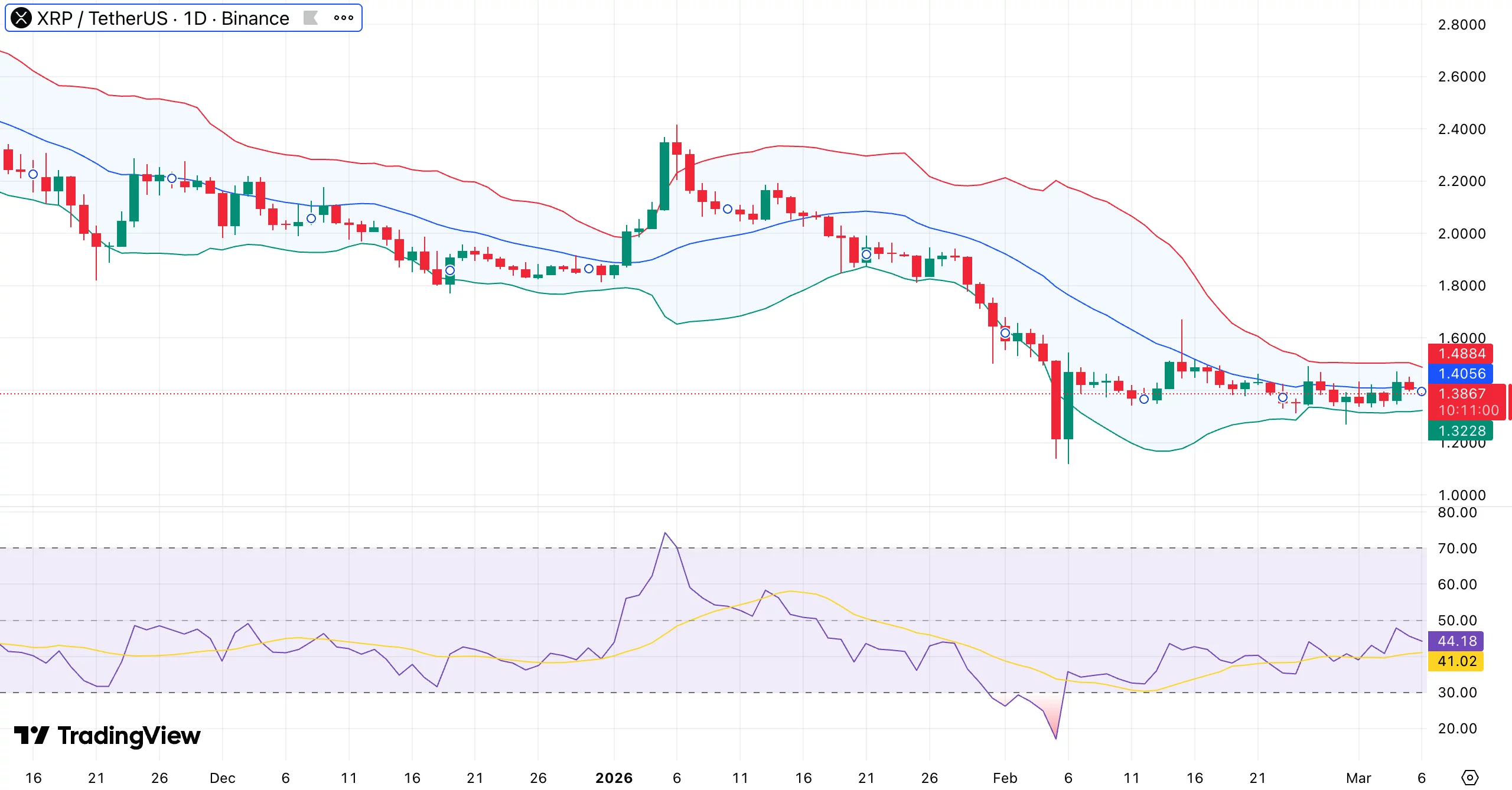
That kind of reaction usually signals that traders are defending the level. Even so, XRP hasn’t yet regained the middle line of the Bollinger Bands, which lines up with the 20-day moving average around $1.40 to $1.42.
As long as the price remains under that mark, short-term momentum still leans slightly bearish. Volatility has also begun to ease. After February’s sharp decline, the Bollinger Bands have narrowed considerably.
This kind of tightening often appears when the market is moving sideways. Historically, these periods of compression tend to come before a larger move once volatility returns.
Momentum indicators are beginning to show modest improvement. The relative strength index, which previously fell to deeply oversold levels near 25, has rebounded to around 44. A move above the neutral 50 mark would signal strengthening bullish momentum.
Even so, the broader trend remains unchanged. Since the peak reached in January, XRP has continued to form lower highs, a classic sign that the downtrend is still technically in place. A decisive break above the $1.50 to $1.60 resistance area would be needed to shift that structure.
The $1.30 support is still the crucial level to keep an eye on for the time being. XRP may attempt a reversal toward $1.50 or even $1.60 if buyers are able to hold it and push the price back above the $1.42 mid-band. However, the next downward targets might show up at $1.20 or even $1.10 if the support gives way.