


Atlas System’s real test may begin when participant growth slows


Disclosure: This article does not represent investment advice. The content and materials featured on this page are for educational purposes only.
Atlas System’s Smart Cycle model gives participants a structured framework to better understand platform mechanics and participation.
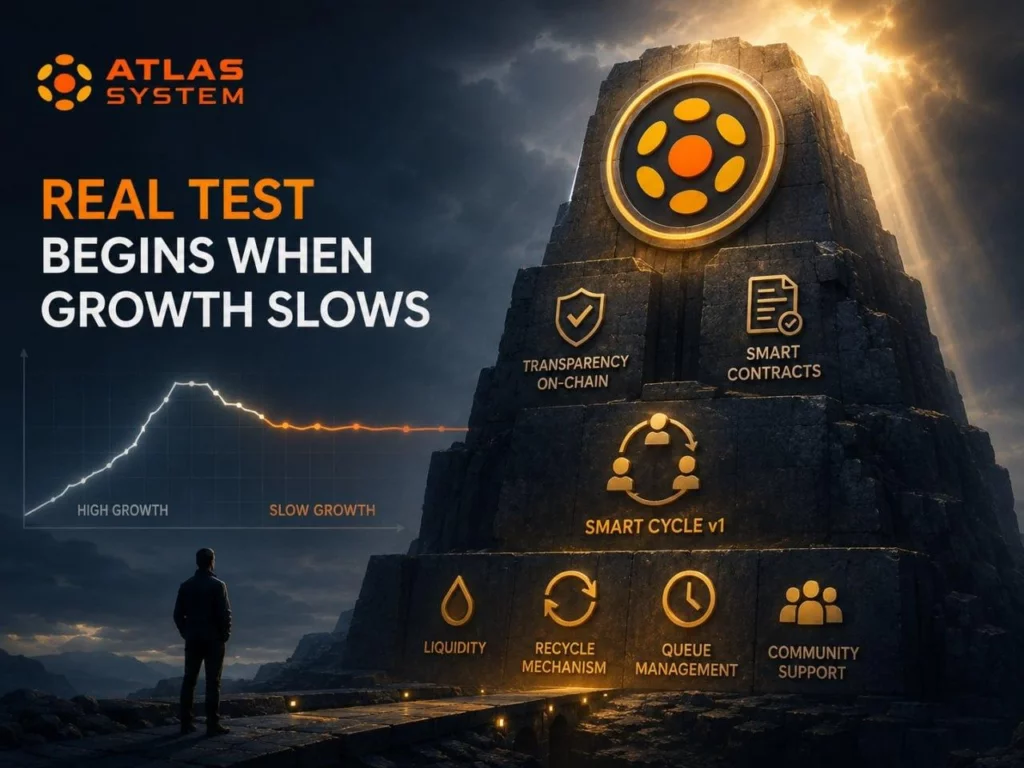
Atlas System is designed around transparent Smart Cycles rather than a hidden external revenue story. That makes its economics easier to inspect, but also makes the central question unavoidable: what happens when fewer new or repeat cycles are created while eligible claims continue to arrive?
Participation-based platforms usually look strongest during expansion. New users arrive, existing users open additional cycles, liquidity grows, and successful claims reinforce confidence. The more revealing period begins when activity slows.
Atlas System’s whitepaper describes each Smart Cycle as a product with a lifecycle: preparation, launch, growth, stabilization, slowdown, completion and transition. During slowdown, activity may decline, claims may depend more heavily on available liquidity, and the risks of late participation increase. Smart Cycle 1 is not presented as an indefinitely operating product.
Atlas also does not describe a separate external business that reliably funds the calculated delta. Its materials say assistance and additional delta are formed within the system through participant activity and available liquidity. The system’s resilience therefore depends less on launch momentum than on how it behaves when inflows and claim demand stop moving in the same direction.
Claims depend on shared liquidity
Smart Cycle v1 uses two main user-facing contracts. Lockup Flow records fixed-term orders and allows an eligible user to request the contributed amount plus a calculated reward after maturity. Daily Flow allows users to claim calculated daily rewards over a 200-day schedule.
Both interact with a shared PancakeSwap V3 liquidity position through PositionHandler. The project’s GitHub documentation says deposits are added to that position, while claims remove corresponding liquidity.
This makes claims visible, but not unconditional. A claim can be valid under the timing rules while still depending on liquidity being available and withdrawable under the contract’s technical conditions.
Cyberscope highlighted this in a critical finding called “First-Come Reward Model.” The auditor said rewards are paid from shared deposited liquidity rather than isolated reward reserves, creating a risk that earlier claimants consume liquidity needed by later participants. It recommended separating participant principal from reward funding and introducing explicit reserve accounting.
There is no formal waiting line
It is tempting to describe this as a queue, but the published contracts do not appear to create a formal first-in, first-out waiting list for unpaid claims. Eligible users initiate their own claim transactions. Based on the published code, execution depends on which valid transaction reaches the contract and succeeds while sufficient liquidity and the required conditions are present. Entry time does not necessarily establish payment priority.
An “on-chain order” therefore means a recorded user position, not a guaranteed place in a payout queue. BscScan can show that a claim was submitted, confirmed or reverted. It cannot guarantee that a later claim will receive the same result as an earlier one.
Repeat cycles can support liquidity but also create future claims
Slower growth does not mean no new funds enter the system. Existing participants may create repeat Smart Cycles, while later versions may attract new activity. The whitepaper describes continued cycle creation and participant behavior as factors that may preserve the active phase. It treats future Smart Cycle versions as separate protocol stages rather than automatic extensions of the previous cycle.
Repeat participation can add liquidity in the near term. But it does not solve the underlying issue by itself. Every new cycle also creates future claim conditions. Repeat cycles can sustain movement while participation remains active, but they are not an external revenue source or guaranteed reserve.
Atlas discusses a possible future support reserve funded through ecosystem fees or a share of calculated delta from later cycles. The whitepaper says such a mechanism, if introduced, might be insufficient and would not guarantee compensation for an earlier cycle.
Transparency is not the same as capacity
Atlas can make contract addresses, transfers, source code and claim transactions visible. This differs from a closed platform where users see only an internal balance. Yet on-chain transparency answers a narrower question: what happened? It can show how much USDT entered a contract, which wallet called a function and whether a transaction succeeded. It does not show that the system will have enough accessible liquidity to execute all future claims.
That is the difference between transparency and capacity. A protocol may execute its code exactly as written while the economic conditions needed for a desired outcome deteriorate. Useful public indicators during a slowdown would include accessible liquidity, the volume and maturity profile of outstanding cycles, successful and reverted claims, upcoming claim concentration and changes to owner-controlled parameters. The interface should also distinguish a calculated amount from an amount guaranteed to be paid.
The real test comes after momentum
Atlas documents describe Smart Cycles as cyclical rather than eternal. But disclosure alone does not establish resilience. The decisive test will come when new and repeat cycle creation slows, matured claims accumulate and participants can observe the results in real time. BscScan will make the system easier to evaluate, but it will not supply the liquidity required to execute claims.
Smart contracts can make rules visible and enforce them consistently. They cannot remove the economic dependency between participant activity, shared liquidity and outgoing requests. For Atlas System, the slowdown phase will show whether transparency helps users understand that dependency before it becomes a crisis.
For more information, visit the official website, GitHub repo, X, Facebook, TikTok, and Telegram.
Disclosure: This content is provided by a third party. Neither crypto.news nor the author of this article endorses any product mentioned on this page. Users should conduct their own research before taking any action related to the company.