
Bitcoin price gains 24% in best August since 2017


Bitcoin traded near $78,400 on Aug. 31 and headed toward its strongest August performance since 2017 after gaining roughly 24% during the month.
- Bitcoin traded near $78,400 after gaining roughly 24% during August, its strongest August since 2017.
- U.S. spot Bitcoin ETFs attracted $1.92 billion during their strongest weekly inflow since October 2025.
- Crypto derivatives recorded $6.55 billion in short liquidations across two weeks, according to CoinGlass data.
- Treasury will double bond buybacks to $4 billion per operation beginning on September 9.
- Bitcoin must reclaim $80,000 to strengthen momentum, while September jobs data could reset rate expectations.
BTC recovered from approximately $63,000 in mid-August and briefly crossed $80,000 before losing momentum near that level. The rally reversed much of the pressure recorded during the first half of 2026.
The final monthly return remains subject to Bitcoin’s closing price. Still, current historical data places August 2026 well ahead of every August since the 2017 bull market.
Bitcoin’s third-quarter return stood near 32% at the time of writing. That compares with losses of approximately 22% during the first quarter and 14% during the second, although September’s performance will determine the final quarterly result.
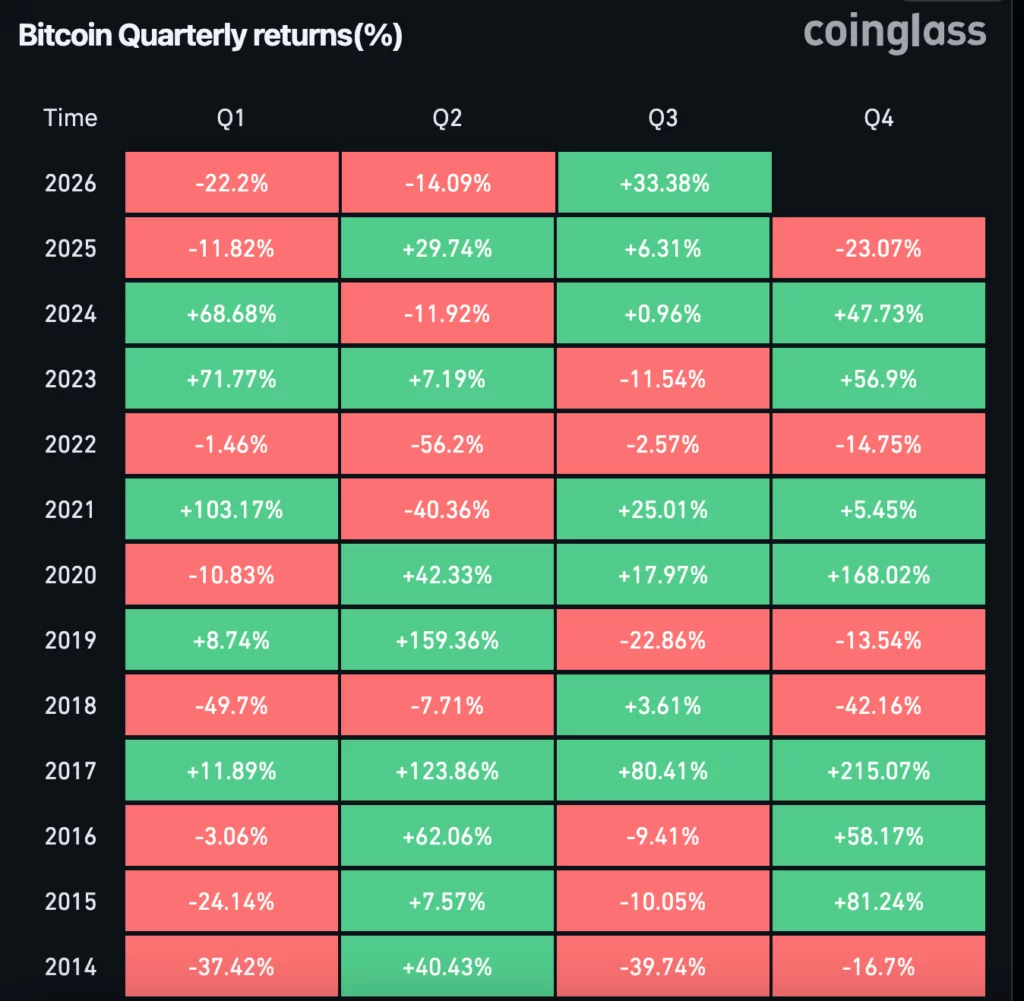
Bitcoin’s August rally reversed a difficult first half
Bitcoin entered August after spending several months under pressure. The cryptocurrency fell toward $58,000 in July before recovering above $60,000 and beginning its sharp late-August advance.
The rally carried BTC beyond $70,000 and eventually above $80,000 for the first time since May. It also pushed the asset above several short-term resistance levels that had restricted previous recovery attempts.
Derivatives positioning amplified the move. Data attributed to CoinGlass showed approximately $9.71 billion in cryptocurrency liquidations across two weeks. Short positions accounted for $6.55 billion, while long liquidations reached $3.16 billion.
Those figures cover the broader cryptocurrency market rather than Bitcoin positions alone. They show that bearish traders absorbed most of the forced closures, but they do not prove that new spot demand caused the entire rally.
As Bitcoin’s 22% advance confronted a demand test, analysts noted that futures open interest measured in BTC had declined. Contained funding rates also suggested short covering contributed to the initial breakout without excessive leveraged long positioning.
ETF inflows provided a clearer demand signal
U.S. spot Bitcoin exchange-traded funds attracted approximately $1.92 billion during the five trading sessions through Aug. 21, according to SoSoValue.
It was their strongest weekly inflow since October 2025. August inflows had reached approximately $2.72 billion by Aug. 24, making the month the strongest of 2026 at that point.
The renewed accumulation followed a difficult period for the products. Spot Bitcoin ETFs recorded heavy redemptions during May and June before investor demand recovered in August.
One session delivered $517 million in net inflows as Bitcoin broke above $70,000. As spot ETF demand strengthened during the breakout, nearly $2.7 billion in bearish cryptocurrency positions was liquidated.
ETF flows provide a more direct measure of regulated U.S. investment demand than futures liquidations. However, daily flows can reverse quickly, making continued September accumulation important for supporting prices near $80,000.
Treasury buybacks shaped the macro backdrop
The U.S. Treasury announced on Aug. 19 that it will at least double its long-end liquidity-support buybacks. Maximum purchases will rise from $2 billion to at least $4 billion per operation.
The expanded program covers Treasury securities in the 10-to-20-year and 20-to-30-year sectors. Operations are scheduled to begin Sept. 9 and continue through Nov. 4, according to the official announcement.
The policy aims to improve trading conditions in parts of the bond market where liquidity has weakened. It is not a direct BTC purchase program, and the Treasury has not described supporting cryptocurrency prices as an objective.
BTC and gold nevertheless rose as bond yields initially declined and the U.S. dollar weakened. Some market participants interpreted the policy as another reason to hold scarce assets, although that explanation remains an analyst view rather than a confirmed causal relationship.
That backdrop has since become less supportive. Federal Reserve Chair Kevin Warsh delivered hawkish remarks at Jackson Hole, prompting markets to raise their expectations for a September interest-rate increase.
Higher rates can strengthen the dollar and increase the opportunity cost of holding assets without yield. These conditions could test whether BTC’s August recovery can survive a less favorable monetary-policy outlook.
Bitcoin faces an $80,000 resistance test in September
Bitcoin ended the month closer to resistance than support. Trader Carl Moon said buyers need to push BTC back above $80,000, warning that failure to reclaim the level could expose the market to a deeper pullback.
Miles Deutscher said the recovery did not resemble a typical “dead cat bounce,” citing Bitcoin’s relationship with gold and increased on-chain activity. However, he questioned whether sufficient external capital was entering the market to sustain the advance.
Fidelity’s Jurrien Timmer said BTC had held the floor of his power-law model and may have satisfied the time component of its four-year correction. The model is an analytical framework, not a guaranteed price signal.
Comparisons with 2017 also require caution. BTC gained 80.41% during the third quarter of 2017 and 215.07% in the fourth. The current market has different liquidity, regulation, derivatives and institutional participation.
The next tests include the Sept. 4 U.S. employment report, Treasury buybacks beginning Sept. 9 and the Federal Reserve’s September decision. Sustained ETF inflows and a confirmed break above $80,000 would provide stronger evidence that August’s rally can continue.
Disclosure: This article does not represent investment advice. The content and materials featured on this page are for educational purposes only.