


Fed rate hike odds hit 46% as Kashkari warns on inflation

Minneapolis Fed President Neel Kashkari backed gradual interest rate increases as persistent inflation and uncertainty around the Strait of Hormuz complicate the outlook for US monetary policy.
- Polymarket traders assigned a 46% probability to a 25-basis-point increase in September.
- Kashkari said the Fed should start raising rates gradually to bring inflation toward its 2% goal.
- The Fed held its benchmark rate at 3.50%–3.75% in July despite three dissenting votes.
- Bitcoin traded near $64,700 as crypto investors assessed the risk of tighter US liquidity.
Kashkari calls for gradual Fed rate hikes
Kashkari said during a CNBC interview on Wednesday that the central bank should begin moving interest rates higher as inflation remains above its target.
“I think now is the time to start slowly moving rates up,” Kashkari said.
The Minneapolis Fed president argued that current monetary policy does not appear particularly restrictive. He pointed to strong corporate earnings and continued economic resilience as signs that higher borrowing costs have not placed substantial pressure on demand.
Kashkari clarified that he was not advocating a series of aggressive increases. Instead, he supported incremental moves intended to reduce inflation without causing an unnecessary slowdown in the US economy.
His remarks add to a growing debate inside the Fed over whether rates are high enough to contain renewed price pressures. Kansas City Fed President Jeff Schmid also called for tighter monetary policy on Wednesday, although he did not specify when or by how much rates should rise.
Fed’s July decision exposed a widening policy split
The Federal Open Market Committee maintained the federal funds rate at 3.50%–3.75% during its July 28–29 meeting.
Kashkari, Cleveland Fed President Beth Hammack, and Dallas Fed President Lorie Logan opposed the decision. All three preferred an immediate quarter-point increase, according to the Federal Reserve’s official statement.
Kashkari later said the dissent reflected his view that policymakers should begin a gradual tightening cycle rather than deliver a sharp increase.
The three dissents showed that concern over inflation is spreading among policymakers. The Fed remains committed to returning inflation to 2%, but higher energy costs and resilient demand have made that task more difficult.
Kashkari said the September decision would depend on inflation reports released before the meeting and developments in the US-Iran conflict. Those factors could determine whether the Fed holds rates steady again or delivers its first increase of the year.
Hormuz uncertainty keeps inflation risks elevated
Disrupted shipping through the Strait of Hormuz has increased energy costs and added another layer of uncertainty to the Fed’s outlook. The waterway remains central to global oil and liquefied natural gas shipments.
Iran and Oman have reached a preliminary understanding on the coordinates of a possible shipping route through the strait. However, negotiations remain incomplete, and the proposed arrangement does not guarantee safe passage, Reuters reported.
President Donald Trump said an agreement to reopen the waterway could arrive this week. A reduction in regional tensions could lower energy prices and ease some inflation pressure, but Kashkari said the Fed must assess the incoming information before committing to a September move.
Continued disruption would create the opposite risk. Higher fuel and transportation costs could spread across the US economy, strengthening the case for tighter monetary policy.
Crypto traders still lean toward a September hold
Polymarket traders placed the probability of a 25-basis-point September increase at about 46%, while the chance of no change stood near 53% when observed. Prediction-market prices change continuously and later moved closer to an even split.
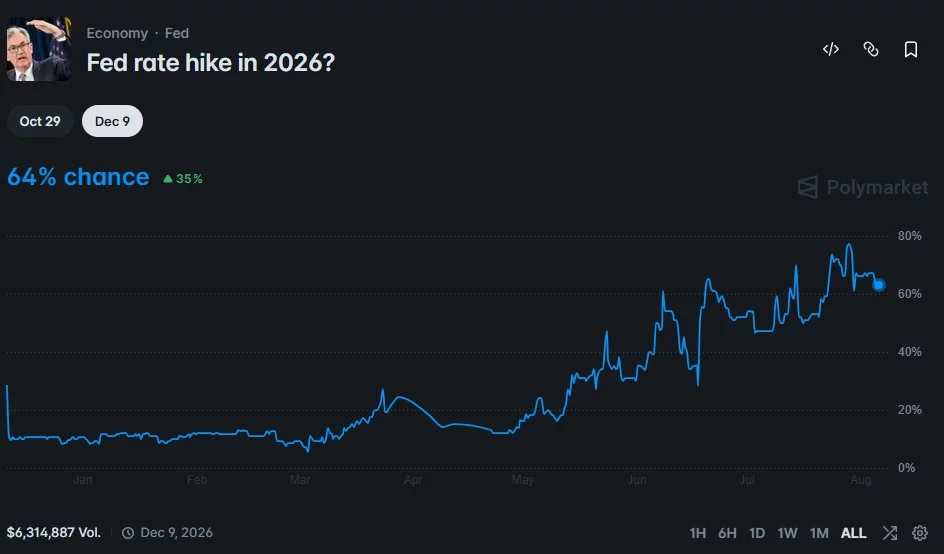
A separate Polymarket contract assigned a 64% probability to at least one rate increase before the end of 2026. That leaves the October and December meetings as possible alternatives if the Fed decides September is too early.
Bitcoin (BTC) traded near $64,700 on Wednesday, holding above its intraday low near $63,900. The move did not establish a direct reaction to Kashkari’s remarks, but the rate outlook remains important for crypto investors.
Higher rates can strengthen the dollar and reduce liquidity available for risk assets, creating pressure on Bitcoin and other cryptocurrencies. A September hold could offer short-term relief, although persistent inflation may keep the prospect of a later increase in focus.
Upcoming inflation data, the July employment report and developments around the Strait of Hormuz will shape expectations before the Fed’s Sept. 15–16 meeting.