
Will Protocol v25 push Pi Network price beyond $0.10?


Pi Network price has rebounded nearly 39% from its July 14 all-time low as traders position for the Protocol v25 upgrade, although its rejection near $0.10 has kept sentiment cautious.
- Pi Network price has rebounded nearly 39% ahead of the Protocol v25 upgrade.
- A close above $0.10 could open a move toward the $0.1197 resistance level.
- Daily token unlocks and a loss of $0.085 could derail the recovery.
According to data from crypto.news, Pi Network (PI) price rose from $0.0704 to an intraday peak near $0.098 before easing to $0.0939 at press time. The token has now surrendered part of its 4-day surge after sellers defended the psychological $0.10 level, but it remains well above last week’s record low.
The July 22 upgrade has supplied the immediate catalyst. Pi Network expects Protocol v25 to improve network stability and add tools for more efficient, privacy-preserving smart contracts. In its announcement, the Pi Core Team wrote:
“On July 22, Pi is scheduled to upgrade to Protocol v25, which primarily focuses on improving network stability and reliability.”
The planned update includes support for BN254 cryptography and Poseidon hashing, two components used in zero-knowledge systems. A redesigned mining application has also brought users back to the ecosystem ahead of the deployment, adding retail interest after months of persistent losses.
Protocol v25 has reopened the path above $0.10
On the daily chart, PI has recovered from the $0.0704 floor but remains inside the descending structure that has controlled price since May. The first major obstacle sits at $0.0979, the 78.6% Fibonacci retracement of the decline from $0.1997.
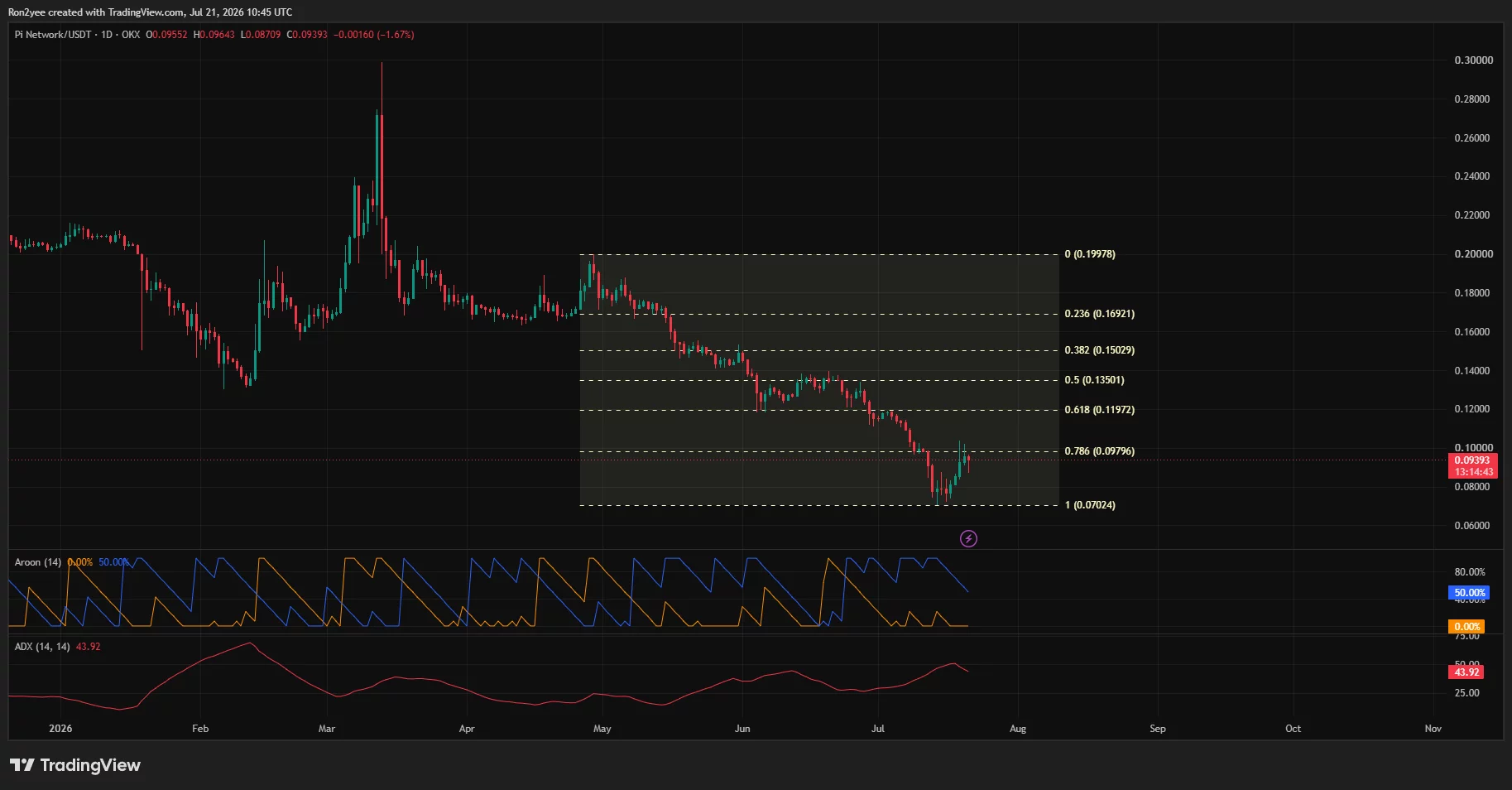
A daily close above $0.0979 would put PI back over the $0.10 barrier and expose the 61.8% Fibonacci level at $0.1197. Beyond that, the next resistance levels stand at $0.1350 and $0.1502. Buyers would need to clear the descending trendline and hold above $0.12 before the chart supports a sustained reversal rather than an oversold bounce.
Momentum has improved but remains uneven. The daily Aroon Up reading stands at 50%, while Aroon Down has fallen to zero, showing that the recent low no longer controls immediate price action. The Average Directional Index remains elevated at 43.92, confirming that PI is still moving through a strong directional phase after its steep July decline.
The 4-hour chart offers a more constructive setup. PI has moved above the Supertrend support at approximately $0.085, turning the indicator bullish for the first time since late June. Chaikin Money Flow has also climbed to 0.12, which shows that buying volume has outweighed selling volume during the recovery.
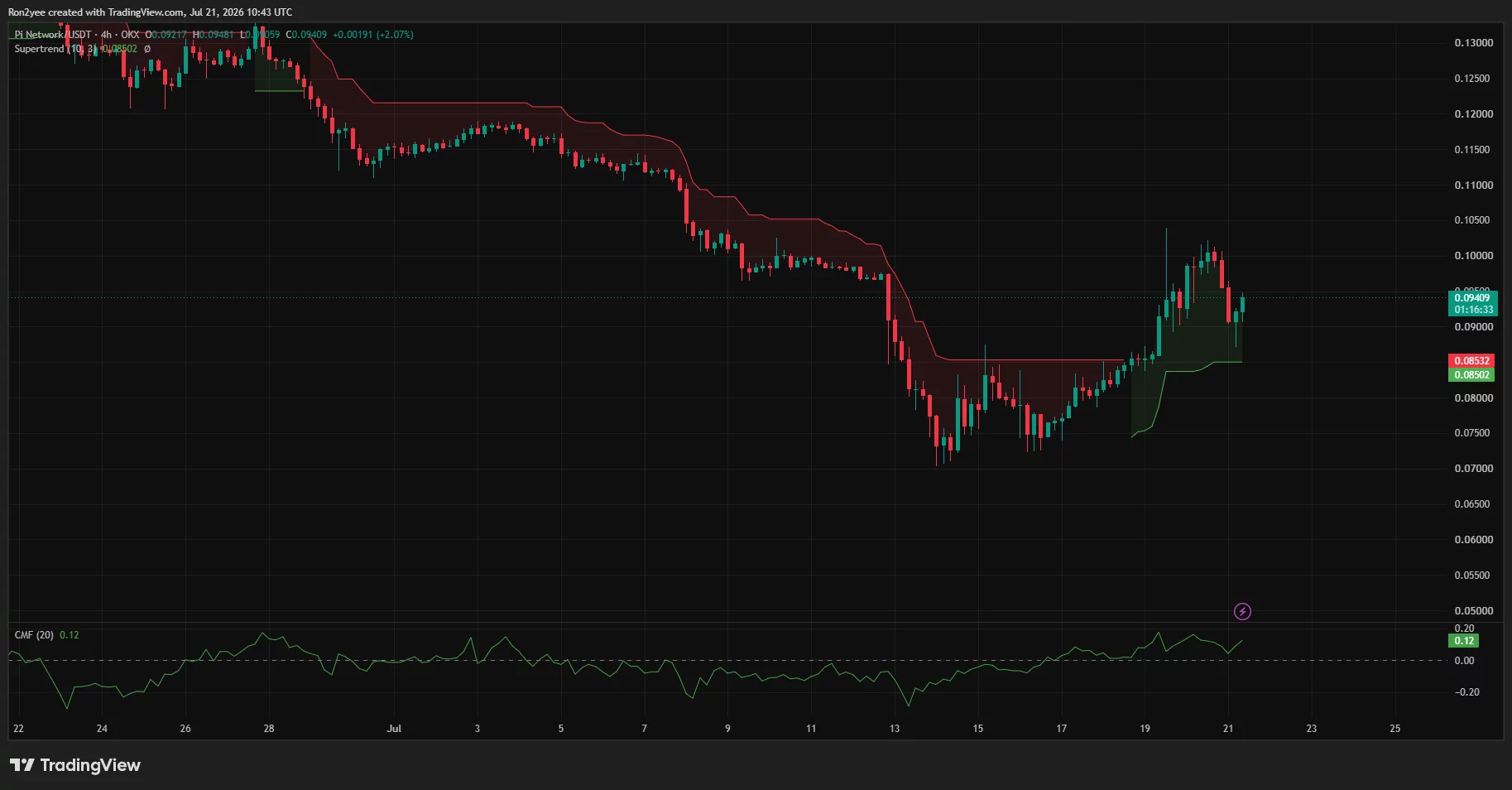
Still, the rejection between $0.10 and $0.104 left a long upper wick on the 4-hour chart. A second attempt at that supply zone would require stronger spot volume; otherwise, short-term traders may continue taking profits whenever PI approaches the round-number resistance.
Derivatives traders have increased their exposure, though leverage remains modest compared with earlier months. CoinAnk data showed PI futures open interest rising from $10.44 million to $10.73 million during the first stage of the rebound, after falling to $9.11 million earlier in the week. In comparison, open interest stood near $28 million at the start of June and reached $35 million during PI’s May rally.
Lower derivatives participation reduces the chance of a large leverage-driven breakout, but it also limits the risk of an immediate long-liquidation cascade. A rise in open interest alongside a confirmed move above $0.10 would show fresh positions entering the market, while falling open interest would leave the advance dependent on spot buyers.
Meanwhile, Bitcoin’s recent recovery toward $65,000 has helped stabilize demand for beaten-down altcoins. Cooler U.S. inflation data and renewed spot Bitcoin ETF inflows improved risk appetite, although geopolitical tensions and uncertainty over the Federal Reserve’s next move continue to restrain speculative capital.
Token unlocks and $0.085 support threaten the recovery
Pi Network’s supply schedule remains the main obstacle to a lasting rally. PiScan data showed that roughly 127.5 million PI were scheduled to unlock over 30 days, equal to an average of 4.25 million tokens per day. Separate estimates place total 2026 unlocks near 1.21 billion PI, forcing new demand to absorb a steady increase in tradable supply.
Exchange access has improved since Kraken introduced PI trading in March, but the token still lacks the deep institutional market found around assets with spot exchange-traded funds, corporate treasury demand, or extensive derivatives coverage. As a result, community participation and retail speculation continue to drive much of its liquidity.
The bullish setup would weaken if PI loses the 4-hour Supertrend and closes below $0.085. Such a move would expose $0.075, followed by the all-time low at $0.0704. A break beneath that floor would invalidate the recovery and return the token to price discovery.
For buyers, a daily close above $0.10 would open a move toward $0.1197, but Protocol v25 must translate into developer activity and lasting token demand. Without those gains, unlock-related selling could turn the upgrade rally into another temporary bounce.
Disclosure: This article does not represent investment advice. The content and materials featured on this page are for educational purposes only.