



5 leading crypto payment gateways


Disclosure: This article does not represent investment advice. The content and materials featured on this page are for educational purposes only.
Crypto payment gateways are gaining traction in 2026 as businesses seek faster, lower-cost digital asset payments without managing blockchain infrastructure themselves.
- Crypto payment gateways let businesses accept digital assets without running blockchain nodes or manual conversions.
- Fees across leading gateways in 2026 range from zero to two percent, varying by volume.
- Automatic stablecoin conversion helps merchants reduce exposure to sharp cryptocurrency price swings during payment settlement.
More companies now treat cryptocurrency as a working payment rail rather than a novelty. Cross-border sellers, SaaS platforms, marketplaces, and online services increasingly want a way to accept digital assets that settles fast, keeps fees low, and skips the friction of traditional card networks.
The gateway market has grown crowded in response, and providers differ sharply on the coins they support, how they tame volatility, where they can legally operate, and whether they hand merchants fiat or keep everything on-chain. Choosing well takes more than scanning a fee table.
A crypto payment gateway sits between a customer’s wallet and a merchant’s books. It generates a payment request, confirms the transaction on-chain, and then forwards the crypto, converts it to a stablecoin, or settles it into a bank account. This entire process happens without the merchant running its own blockchain infrastructure.
The five gateways below stand out in 2026, each with the data points that matter for businesses weighing them.
1. NOWPayments
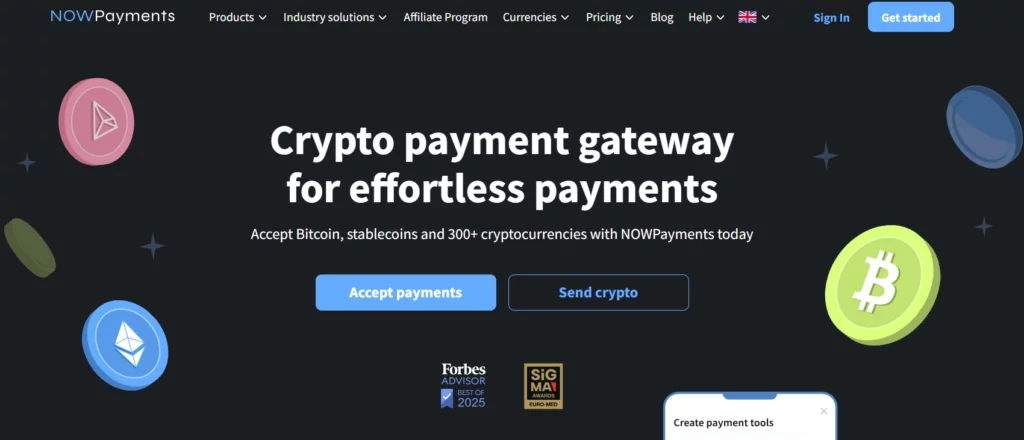
NOWPayments has become a default name in many 2026 gateway comparisons, largely on the strength of its coin coverage. The platform supports Bitcoin, Ethereum, USDT and more than 350 cryptocurrencies, with 30-plus stablecoins among them. Its pricing is usage-based: 0.5% for payments without conversion and 1% for multi-currency transactions that involve conversion, and it charges no setup or recurring monthly fees for standard gateway use.
Merchants can also pick a non-custodial settlement option that keeps funds under their own control, and the gateway plugs into common e-commerce systems for subscriptions, mass payouts, and treasury tasks.
Few rivals match NOWPayments’ asset list or combine acceptance, conversion, and payout tools so completely in one place. The trade-off is that fiat off-ramping may depend on third-party providers and regions. Aside from that, customer checkout confirmations face delays during times of network congestion or downtime on external chains (like Ethereum or Bitcoin).
2. Trybit
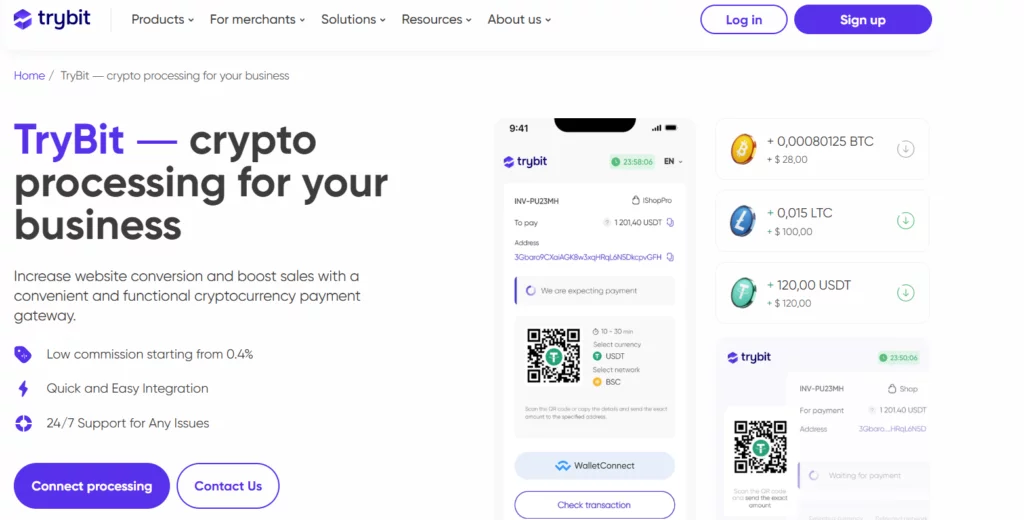
Trybit positions itself as a global crypto acquiring service built for online businesses running high-volume operations. It supports 40-plus cryptocurrencies and stablecoins and offers three integration paths — a full API, ready-made CMS plugins, or a drop-in HTML widget — so teams can add crypto checkout without heavy engineering. Trybit has a standard merchant fee of 1.9%, with individual rates starting from 0.4% for large clients with high transaction volume, and commercial terms that scale with a project’s activity.
Three problems shape most international crypto operations, and Trybit aims squarely at each. On rising volume, the platform is built to handle growing payment activity so processing stays stable as transactions climb. On volatility, an automatic conversion feature turns incoming payments into supported stablecoins, trimming exposure to price swings without manual hedging.
On transaction risk, incoming funds pass through AML and KYT (Know Your Transaction) screening, which blocks suspicious money before it creates compliance or liquidity headaches during later withdrawal or exchange. Beyond that, Trybit states 99.9% uptime across payment, payout, and exchange operations, and bundles automatic scheduled withdrawals, mass payouts, permanent wallet addresses, and detailed transaction tracking.
One limitation is that Trybit focuses on crypto-to-crypto payment infrastructure rather than fiat on/off-ramp services, so funds are processed and kept within the crypto ecosystem.
3. CoinGate
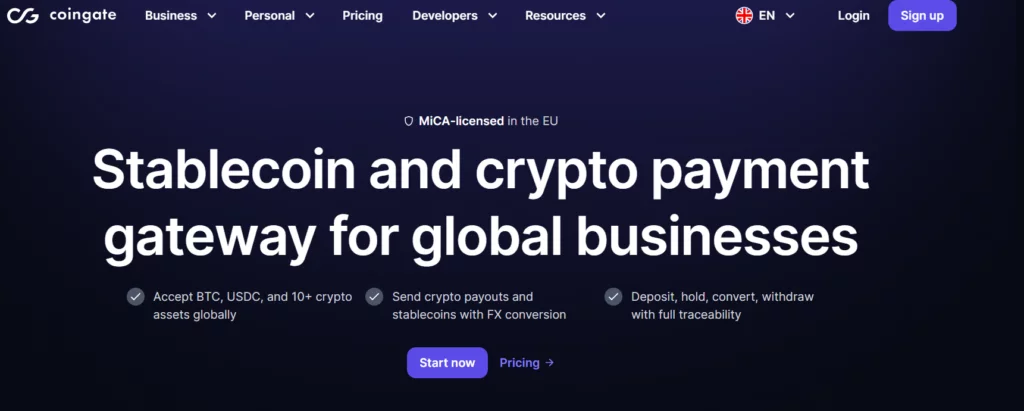
Founded in Lithuania in 2014, CoinGate has spent a decade building one of Europe’s most established gateways, and now serves more than 100,000 stores across 150-plus countries. It supports Bitcoin, Ethereum, and roughly 70 coins in total, including stablecoins such as USDT and USDC, and charges a flat 1% per transaction with no monthly or setup fees.
The platform’s clearest draw is compliance. CoinGate operates under MiCA-licensed EU rules and settles in EUR, USD, and GBP, locking the exchange rate at the moment of payment to protect against volatility. A mobile point-of-sale app and plug-ins for WooCommerce, Shopify, and Magento round out the package.
Regulated EU standing plus straightforward fiat settlement make CoinGate a comfortable fit for European online businesses. The catch is reach and cost. CoinGate does not serve every market, including the United States, and its 1% rate sits at the higher end for merchants that do not need fiat payouts.
4. BitPay
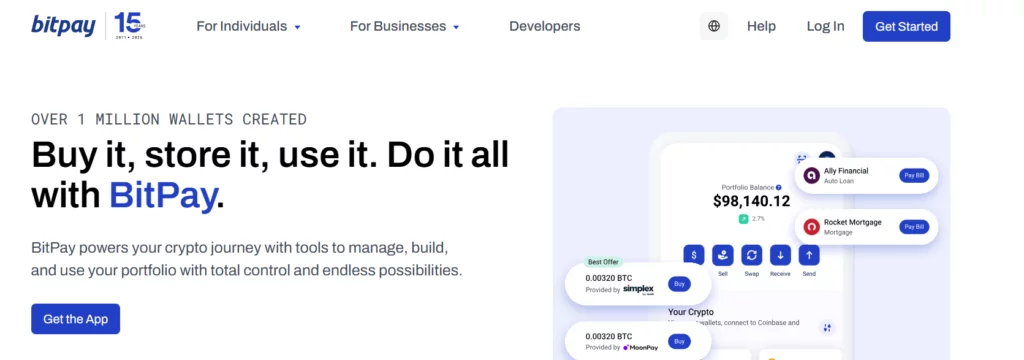
Launched in 2011 and headquartered in Atlanta, BitPay is one of the pioneering processors in the space, letting businesses accept crypto while settling in their preferred fiat currency. It supports a curated set of high-liquidity assets including Bitcoin, Ethereum, Litecoin, XRP, Dogecoin, Bitcoin Cash, and stablecoins including USDC and USDT, which suits US merchants that want predictable reporting.
On pricing, BitPay charges 1% to 2% plus a fixed $0.25 per paid invoice, with the tier based on monthly order value. Its exchange-rate lock secures the conversion rate the moment a transaction starts, and it integrates with Shopify, WooCommerce, and Magento, alongside point-of-sale options for physical retail.
A long track record, fiat settlement, and rate locking suit established, higher-volume US businesses. The downside is a narrower coin list than several rivals, and the fixed per-invoice component can bite on small-ticket transactions.
5. Binance Pay

Binance Pay takes a different shape. Rather than a gateway that settles to a bank, it runs a closed-loop network. As of March 2026, it served more than 21 million merchants, and it supports over 300 cryptocurrencies with zero transaction fees and no gas fees for users. It has leaned into QR-code payments across Asia Pacific and Latin America, and stablecoins such as USDT and USDC account for the bulk of its business-to-consumer volume.
No transaction fee, near-instant settlement, and a vast built-in user base make Binance Pay powerful where customers already hold Binance accounts. Its main limitation is that the closed-loop model works best when both sides stay inside the Binance ecosystem, and the brand faces regulatory hurdles in some Western jurisdictions.
How the five compare
| Gateway | Supported assets | Typical fee | Settlement | Best for |
| NOWPayments | 300+ | ~0.5% – 1% | Crypto/stablecoin, custodial or non-custodial | Widest coin coverage |
| Trybit | 40+ | From 0.4% (1.9% standard) | Crypto/stablecoin | High-volume, volatility control |
| CoinGate | ~70 | 1% | Fiat (EUR/USD/GBP) or crypto | EU-regulated fiat settlement |
| BitPay | Curated majors | 1% – 2% + $0.25 | Fiat or crypto | Established US merchants |
| Binance Pay | 300+ | 0% | Binance account | Binance-ecosystem customers |
Final thoughts
No single gateway wins for every business; the right pick depends on business needs. NOWPayments offers the broadest reach and the most flexible tool mix for merchants who want options. CoinGate and BitPay bring regulated fiat settlement for European and US operations. Binance Pay rewards businesses whose customers already live inside its ecosystem. For high-volume, cross-border operators most worried about price swings and risky inflows, Trybit‘s stablecoin auto-conversion, AML and KYT screening, and payout automation make it a strong contender. Whichever a company picks, confirming live fees, supported coins, and regional availability before signing remains the smart move, since those terms change quickly.
Disclosure: This content is provided by a third party. Neither crypto.news nor the author of this article endorses any product mentioned on this page. Users should conduct their own research before taking any action related to the company.