

Two poison pills, one bill: how CLARITY Act got stuck from both sides

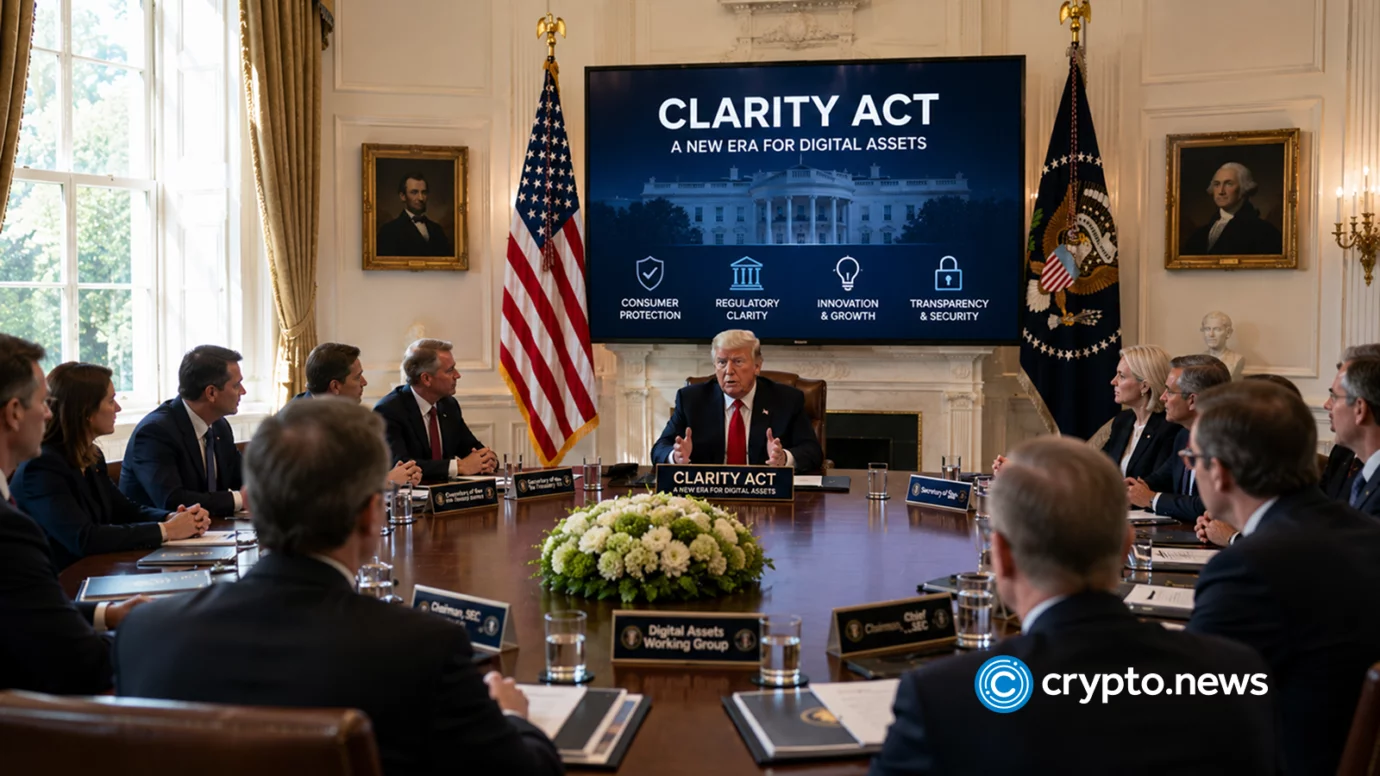
Crypto’s market structure bill cleared committee and then walked into a trap with two jaws. One fight is about the President’s crypto fortune. The other is about whether writing code makes you a money transmitter. Neither side will move, and the clock is running out.
- The CLARITY Act is no longer stuck on one dispute. It is trapped between an ethics fight and a developer-liability fight at the same time.
- The ethics fight centers on whether crypto conflict-of-interest rules should have enforcement teeth strong enough to reach the President’s crypto holdings.
- Section 604 has become its own veto point because developers think it is already too weak, while law enforcement argues it is still too broad.
- The bill’s biggest enemy may now be the calendar. With only 31 Senate session days before the August recess, unresolved disputes could push the framework beyond 2026.
A month ago the CLARITY Act looked close to inevitable. The Senate Banking Committee had advanced it 15 to 9 on May 14, two Democrats had crossed the aisle, the bill landed on the Senate Legislative Calendar on June 1, and prediction markets priced its 2026 passage near 74%. Senator Cynthia Lummis, one of its architects, called the committee vote the most consequential Senate action on crypto regulation in history. The industry allowed itself to believe the market structure bill it had wanted for years was finally going to happen.
Then the trap closed. By mid-June, Polymarket’s passage odds had fallen to roughly 48%, a coin flip, down 26 points in a month. An ethics agreement that negotiators thought they had collapsed in a closed-door meeting on a Tuesday. A second front opened almost simultaneously, with the nation’s largest law enforcement organizations mobilizing against a single section of the bill.
Two Democratic senators tied their votes to the first fight, two more tied theirs to the second, and the bill that needed seven Democratic crossovers to reach 60 suddenly faced four senators pulling in incompatible directions. With 31 Senate session days left before the August recess, CLARITY Act is stuck, and it is stuck in the worst possible way: not from a single objection that could be negotiated away, but from two unrelated poison pills lodged on opposite sides of the bill, each defended by people who will not move.
What follows lays out the trap: the two fights, why each is intractable on its own, why they are far worse together, the irony that connects them through one section of the bill, and what a two-sided stall means for whether crypto gets its framework in 2026 or starts over from nothing.
Poison pill one: the President’s crypto fortune
First, the fight most people know about, and it is intractable because it is not really about crypto at all. Democrats on the Banking Committee conditioned their support on ethics provisions restricting government officials from conflicts of interest in crypto, a demand driven directly by the business activities of President Trump’s family. The scale of those activities is the reason the demand will not go away: since returning to office, Trump and his family have generated an estimated $2.3 billion from crypto ventures, according to Reuters, spanning a personal memecoin, a family-linked venture with its own token and a dollar stablecoin, mining interests, and a media company with a crypto treasury. No previous administration has held positions remotely like these while crypto legislation moved through Congress, and the legislation itself would shape the value of several of them.
For Democrats, a market structure law written without ethics rails would mean regulating an industry in which the signing official holds billions in personal positions. Senator Ruben Gallego, one of the two Democrats who supplied the decisive committee votes, drew the line in public: the group had come close but not finished an agreement on ethics guardrails for all elected officials, and if it was not resolved by the floor vote, he was not afraid to vote no. Senator Angela Alsobrooks, the other crossover, has signaled she may need further negotiation before committing on the floor. The two votes that carried the bill out of committee are explicitly conditional, and the condition is ethics.
The White House holds its own line, and the two lines do not meet. The administration will accept rules that apply across the board, from the President down to the newest intern, but rejects anything it reads as targeting a specific officeholder. That formula sounds like room for compromise until you watch what happens when negotiators try to write it down, which is exactly what happened on the Tuesday the deal collapsed.
How the ethics deal actually collapsed
The collapse is worth getting right in detail, because it reveals why this fight resists the usual legislative solvent of splitting the difference. The closed-door meeting brought together Senators Kirsten Gillibrand, Gallego, Bernie Moreno, and Lummis, along with White House Crypto Council director Patrick Witt. It was the first ethics meeting since a bipartisan group reached a tentative framework back in May, and it was supposed to convert that framework into agreed text. It collapsed when Republicans and the White House withdrew a specific provision: language that would have let state attorneys general sue the Department of Justice over failures to enforce ethics rules tied to the President’s crypto interests.
That withdrawn provision contains the whole fight. An ethics rule without an enforcement mechanism is a statement of principle; an ethics rule that lets state AGs sue the DOJ for not enforcing it is a weapon, one that could be pointed directly at the administration’s handling of the President’s holdings. Democrats wanted the enforcement teeth precisely because a rule the DOJ can decline to enforce is, against this administration, no rule at all. The White House withdrew the teeth precisely because a mechanism letting partisan state AGs drag the DOJ into court over the President’s businesses is the targeting it said it would never accept.
Both sides are correct about what the provision does, which is why neither will yield. The enforcement teeth are the compromise and the dealbreaker at the same time, depending on which side of the table you sit. A true poison pill works this way. It is not a number to be split or a date to be moved. It is a binary, where the thing one side needs to vote yes is the precise thing the other side cannot accept, and no drafting cleverness dissolves it, because the disagreement is about the underlying reality the words describe, not the words.
This is why the conflict-of-interest fight examined in depth matters so much to the bill’s floor math. It is not just a messaging dispute around Trump’s crypto activity. It is the condition attached to the very Democratic votes that helped the bill leave committee.
Poison pill two: is writing code money transmission?
Second, the fight almost nobody outside the policy weeds is tracking, and it may be the more dangerous of the two because it pits the crypto industry’s allies against each other. Section 604 of the Senate draft is the Blockchain Regulatory Certainty Act, and its purpose is to settle a question that has hung over crypto development for a decade: is a person who writes blockchain software, but who cannot control or move users’ assets, a money transmitter subject to the full weight of financial-surveillance law? Section 604 says no. It defines a non-controlling developer or provider as one lacking the legal right or unilateral ability to control or initiate user transactions, and it limits money-transmitter treatment to parties who actually control or move assets, leaving developers who write distributed-ledger software, build self-custody tools, or support blockchain infrastructure outside that classification.
For the crypto industry, Section 604 is close to sacred. It codifies a principle the Department of Justice itself articulated in 2025, when a senior official said that merely writing code, without ill intent, is not a crime. It protects the open-source developers who build the rails without ever touching user funds, and stripping it would leave them exposed to prosecution as unlicensed money transmitters for the act of publishing software. When crypto industry heavyweights signed letters urging the Senate to pass CLARITY, the phrase they kept repeating was “with developer protections intact.” Section 604 is the protection they mean.
For law enforcement, Section 604 is a loophole. The National Sheriffs’ Association, the Fraternal Order of Police, and the National District Attorneys’ Association have mobilized against it, arguing the provision could make it harder to pursue bad actors operating on-chain, hampering investigations into money laundering and other illicit finance. Their case rests on real numbers: TRM Labs estimated illicit crypto volume reached $158 billion in 2025, up nearly 145% from the prior year, and the FBI’s 2025 report found crypto investment fraud alone generated $7.2 billion in reported losses. The police organizations worry that a statute placing developers categorically outside money-transmitter rules removes a tool they use to reach the infrastructure criminals rely on.
Why the second fight has its own veto bloc
Law enforcement’s objection would be background noise if it did not come attached to votes, and it does. Senators Mark Warner and Catherine Cortez Masto have tied their support for CLARITY Act to law enforcement’s sign-off on Section 604. That sentence is the structural problem. The bill already needs roughly seven Democrats beyond the two committee crossovers to clear the 60-vote threshold, and two of the most gettable Democrats have made their votes contingent not on ethics, the first poison pill, but on a completely separate objection that the crypto industry’s own allies consider an attack on the bill’s core protections.
The pro-crypto Democrats are not even unified among themselves: a group of five, Warner, Cortez Masto, Raphael Warnock, Alsobrooks, and Gallego, met in Warner’s office to discuss strategy before the committee markup, and they want different and partly incompatible things from the same bill. The White House sees the danger and is working the law enforcement front directly. The White House Crypto Council convened representatives from the major police and prosecutor organizations, alongside officials from the DOJ, Treasury, and FinCEN, to address the Section 604 objections, with crypto adviser Patrick Witt arguing the bill is pro-regulatory and pro-enforcement and that the developer language does not shield criminals.
Whether that lobbying succeeds is unknown, but its mere necessity tells the story: in June 2026, the administration is spending political capital persuading sheriffs, not just senators, because the sheriffs now hold a bloc of Democratic votes through Warner and Cortez Masto.
The cruel irony: one section, both directions
One detail in CLARITY’s stall is almost too neat, and most coverage misses it. Section 604 has already been cut once, and the cutting is what set up the current trap. In the frantic dealmaking before the May 14 committee vote, negotiators removed language from Section 301 of the bill that referenced the Blockchain Regulatory Certainty Act in Section 604, weakening the protections for non-custodial DeFi developers as the price of getting Gallego and Alsobrooks to yes. DeFi advocates raised alarms immediately, warning that the change could strip critical developer protections and leave open-source builders exposed to the vague standard of exercising control through agreements or understandings, which regulators could later stretch to cover governance-token voting or protocol participation.
The industry won the committee vote by partly sacrificing the developer protection it cares about most. Now watch the geometry that creates. The developer protection was already weakened to pass committee, which enraged the crypto-native DeFi camp. The remaining protection is still strong enough that law enforcement is fighting to weaken it further, which has captured Warner and Cortez Masto.
So Section 604 is simultaneously too weak for the developers who want it strengthened back and too strong for the police who want it cut more, and any move in either direction loses votes on the opposite side. Strengthen it to win back DeFi advocates and the broader developer base, and you harden the law enforcement bloc against the bill. Weaken it to satisfy the sheriffs and Warner and Cortez Masto, and you lose the developer-protection argument that is half the industry’s reason for wanting CLARITY Act at all. One section of one bill is being pulled in both directions at once, and there is no position for it that does not bleed votes somewhere.
That is why it functions as a two-sided poison pill instead of two separate problems. The ethics fight and the Section 604 fight are different disputes with different antagonists, but Section 604 itself contains a second internal poison pill, a provision that cannot be set anywhere on the dial without losing the votes the bill needs. A bill can sometimes route around one intractable clause. Routing around two, one of which is internally self-contradicting, inside 31 session days, is a different order of difficulty.
The vote math that makes it fatal
The arithmetic is where the two poison pills turn from survivable to fatal, because in a friendlier vote environment they would be neither. CLARITY Act needs 60 votes to break a filibuster. The committee vote was 15 to 9, mostly along party lines, with all 13 Republicans and just two Democrats. Reaching 60 on the floor requires roughly seven Democrats beyond those two, which means the bill must hold both committee crossovers and add five more, all from a caucus with two separate reasons to withhold support.
The two ethics-conditioned votes, Gallego and Alsobrooks, and the two enforcement-conditioned votes, Warner and Cortez Masto, are four of the most plausible Democratic yes votes, and all four are currently contingent on fights that point in incompatible directions. Satisfying the ethics bloc does nothing for the enforcement bloc, and vice versa. The bill cannot trade one group’s price for the other’s, because they are buying different things.
This is before even adding the third fight running inside the bill: the stablecoin-yield dispute between banks and crypto firms. That fight is not the central trap in this piece, but it shows how crowded the bill’s risk map has become. A market-structure bill that already had to solve the SEC-CFTC split is now carrying ethics, developer liability, law enforcement, and banking-industry pressure at the same time.
The calendar turns that difficulty into a deadline. With 31 session days before the August recess and no floor date yet announced, the bill needs floor time it has not been promised, in a Senate competing with appropriations, surveillance reauthorization, and everything else, during an election year that makes every Democratic vote to hand the administration a signing ceremony more costly as November approaches. Bill sponsors have suggested that if CLARITY Act does not pass in this window, reconsideration before 2030 is unlikely, which raises the stakes of the recess from a delay to a potential multi-year reset. Galaxy Research still estimates a 60 to 75% chance of passage in 2026 and a possible signing the week of August 3, but the prediction markets, at 48%, are pricing the two poison pills more pessimistically than the research desks, and the prediction markets moved 26 points in a month while the fundamentals deteriorated.
Why two pills are worse than twice one pill
Instinct treats two problems as additive, two fights to win instead of one. The reality is multiplicative, and understanding why explains the odds collapse. A single poison pill creates a negotiation with one axis. Both sides know what they are fighting over, the coalition that wants the bill can focus its energy on one compromise, and success requires moving one group.
Two poison pills on opposite sides create a negotiation with no stable solution, because every move to satisfy one bloc can alienate the other, and the coalition’s energy splits between two fronts that do not reinforce each other. Worse, the two fights attract different and partly opposed constituencies into the same bill: the ethics fight pulls in good-government Democrats and the White House’s defenders of presidential prerogative, while the Section 604 fight pulls in law enforcement and the open-source developer lobby, and these groups have no reason to trade with each other because they care about different sections. There is no grand bargain available, because a grand bargain requires the parties to want things they can exchange, and ethics hawks have nothing the sheriffs want.
A deeper problem: two simultaneous fights consume the one resource the bill cannot replace: time and floor attention inside a closing window. Even if each fight were individually winnable in three weeks, two fights running in parallel, each requiring leadership focus, each capable of reopening if the other’s solution disturbs the coalition, can easily consume the entire 31-day runway without either resolving. The bill does not need to lose either fight outright to die. It only needs both fights to stay unresolved when the recess arrives, and a two-front stall is far more likely to run out the clock than a one-front stall, because there are two ways to fail and they interfere with each other’s solutions.
What happens if the clock wins
At 48% odds, the failure scenario is no longer a tail risk, and it should be taken seriously instead of waved away. If neither poison pill is resolved before the August recess, the practical window for 2026 passage may close, and th e bill’s sponsors have suggested reconsideration could wait years. A reset would send the framework back to drafts in the next Congress, under unknown majorities after the midterms, with the GENIUS Act’s stablecoin rules as the only major crypto statute on the books and everything else, market structure, the SEC-CFTC jurisdiction split, the developer protections, the commodity classifications, left to agencies governing by enforcement and interpretation.
For the assets whose legal status CLARITY Act would settle, most consequentially the large non-Bitcoin tokens carrying classification overhangs, a reset means their agency-level treatment stays reversible by the next administration, which is the precise uncertainty that the statute exists to remove. That is what the bill would unlock for XRP if it passes, and why XRP remains the asset with the most riding on the outcome. If CLARITY Act stalls, XRP does not merely lose a near-term legislative catalyst. It loses the statutory certainty that ETF access alone could not provide.
A two-sided death carries its own irony: the bill would fail not because the country rejected crypto market structure, which polls as broadly bipartisan, but because two narrow and unrelated fights, one about one family’s holdings and one about the liability of software developers, occupied the same bill at the same time and neither could be settled before the calendar expired. CLARITY Act would die not from opposition to its purpose but from the geometry of its obstacles, which is a worse and more frustrating way for legislation to fail, because nobody actually voted against the thing itself.
What to watch
The next several weeks come down to a short watch list with the two pills as the axes. On the ethics front, watch whether any enforcement mechanism survives that both Democrats and the White House can accept, since the collapse centered on the state-AG-versus-DOJ provision, and watch Gallego and Alsobrooks specifically, whose public statements will move before their votes do. On the Section 604 front, watch the outcome of the White House Crypto Council’s law enforcement outreach, watch Warner and Cortez Masto for any sign the sheriffs have been satisfied, and watch the DeFi advocates for whether a strengthened developer protection re-enters the text, which would help one bloc while threatening the other.
Above both, watch the full procedural map and calendar: a floor date being scheduled at all would signal that leadership believes one or both pills are close to resolution, and continued silence on a date signals the opposite. And watch the prediction markets as a real-time gauge, since they fell from 74% to 48% as the pills hardened and will move first if either softens.
A bill caught in its own machinery
CLARITY’s stall is a specific kind of legislative tragedy, the kind where a bill with majority support and genuine momentum gets caught not by its enemies but by two unrelated disputes that happened to lodge in the same text at the same time. The ethics fight and the Section 604 fight have nothing to do with each other; one is about a President’s fortune and the other about a developer’s liability. They share only a vehicle, and that shared vehicle is now being pulled apart between them, with four senators holding votes hostage to two incompatible demands and a calendar that gives the coalition no time to satisfy both.
Cruelest of all is the symmetry. Each poison pill is defended by people with a real grievance: Democrats are right that regulating an industry while the signing official profits from it is a genuine conflict, and law enforcement is right that $158 billion in illicit volume is a real problem deserving real tools. Neither side is acting in bad faith, which is exactly why neither will fold, and a bill caught between two good-faith intractable positions is harder to save than one caught between a good-faith position and a bad-faith one.
The 48% on the prediction markets is not pessimism. It is an accurate reading of a bill that has to thread two needles pointing in opposite directions, inside a month, in an election year, and that has already watched one of the needles, Section 604, prove it cannot be threaded from either end. The clock, more than any senator, may end up casting the deciding vote.
Frequently Asked Questions
What are the two issues blocking the CLARITY Act?
Two unrelated disputes have stalled the bill. The first is an ethics fight: Democrats want provisions restricting government officials, especially President Trump and his family, from crypto conflicts of interest, after the family generated an estimated $2.3 billion from crypto ventures. The second is over Section 604, the Blockchain Regulatory Certainty Act, which protects software developers from being treated as money transmitters; law enforcement groups object that it could hamper investigations. Two Democratic senators are tied to each fight, and the demands point in incompatible directions.
What is Section 604 of the CLARITY Act?
Section 604 is the Blockchain Regulatory Certainty Act provision. It defines a non-controlling developer as one who cannot control or move user assets and limits money-transmitter treatment to parties who actually handle funds, shielding open-source developers who write blockchain software from prosecution as unlicensed money transmitters. The crypto industry considers it essential developer protection; the National Sheriffs’ Association, Fraternal Order of Police, and National District Attorneys’ Association argue it could make pursuing on-chain criminals harder.
Why did the CLARITY Act’s ethics agreement collapse?
A closed-door meeting collapsed when Republicans and the White House withdrew a provision that would have let state attorneys general sue the Department of Justice over failures to enforce ethics rules tied to the President’s crypto interests. Democrats wanted that enforcement mechanism because a rule the DOJ can decline to enforce is weak against the current administration; the White House rejected it as targeting the President. The enforcement teeth were both the compromise and the dealbreaker, which is why the meeting ended without agreement.
What are the CLARITY Act’s odds of passing in 2026?
Prediction markets price 2026 passage near 48% as of mid-June, down from 74% a month earlier, as the two poison pills hardened. Research desks are more optimistic, with Galaxy Research estimating 60 to 75% and a possible signing the week of August 3. The bill needs 60 Senate votes, roughly seven Democrats beyond the two committee crossovers, with 31 session days left before the August recess and no floor date scheduled.
Why are two problems so much harder than one for the bill?
A single dispute creates a negotiation with one axis that the bill’s coalition can focus on resolving. Two disputes on opposite sides create a negotiation with no stable solution, because satisfying one bloc can alienate the other, and the two fights attract different constituencies with nothing to trade. Section 604 makes it worse: it was already weakened once to pass committee, so it is now too weak for developers and too strong for police at the same time, meaning any move loses votes somewhere. The two fights also consume the scarce floor time the bill cannot replace.
What happens to crypto if the CLARITY Act fails in 2026?
If neither dispute resolves before the August recess, the 2026 window may close, and sponsors have suggested reconsideration could wait years. The framework would reset to drafts in the next Congress under post-midterm majorities, leaving the GENIUS Act’s stablecoin rules as the only major crypto statute and everything else, the SEC-CFTC split, developer protections, and commodity classifications, to agencies governing by enforcement and reversible interpretation. The assets most affected are the large non-Bitcoin tokens whose legal status the bill would have settled permanently.
As of June 15, 2026. Legislative status changes rapidly; verify the current state of negotiations before relying on this analysis. This article is information, not investment advice.