






John Thune shuts down hopes for CLARITY Act vote before recess


Senate Majority Leader John Thune has ruled out passage of the CLARITY Act before the August recess, as Polymarket traders cut its chance of becoming law in 2026 to 33%.
- John Thune has ruled out CLARITY Act passage before the Senate’s August recess.
- Ron Hammond says election politics is drowning out the bill’s bipartisan support.
- Polymarket traders now give the CLARITY Act a 33% chance of passage in 2026.
Fortune reported on July 24 that Thune does not expect the Senate to approve the crypto market structure bill before lawmakers leave Washington, removing a deadline that industry supporters had viewed as critical to its passage this year.
Attention has now moved to the short period after the November midterm elections, when Congress will return with government funding measures, defense legislation and other unfinished business competing for floor time. Ron Hammond, head of policy and advocacy at Wintermute, told Fortune that the bill still has enough bipartisan support but has become caught in election-year disputes.
Hammond argued that political messaging, rather than an absence of Senate votes, has become the immediate problem. With Democrats preparing to campaign against President Donald Trump and alleged corruption, he expects some lawmakers to avoid supporting a major crypto bill before voters go to the polls.
“The votes are there, but the election politics are louder. The latter will dissipate after November and that’s a narrow but very possible window,” Hammond told Fortune.
Election politics has become the main obstacle
A dispute over Trump’s crypto businesses has complicated negotiations even after Republicans signaled that they would consider limits on digital asset activity by elected officials. Senate Democrats have demanded provisions preventing senior government figures from using public office to profit from crypto ventures.
Under the latest draft, ethics restrictions involving Trump and other federal officials would be enforced through the Department of Justice. Several Democratic lawmakers have rejected that approach because the department operates under the executive branch and, in their view, should not hold sole enforcement power over a sitting president.
Seven Senate Democrats have also opposed the updated text over ethics, consumer protection and enforcement concerns, according to a July 23 crypto.news report. Republicans hold 53 Senate seats and would need support from at least seven Democrats to reach the 60 votes usually required to advance the legislation.
Senate Minority Leader Chuck Schumer has encouraged Democrats to center their midterm message on allegations of corruption involving Trump, Fortune reported. Hammond believes that strategy could make Democratic senators less willing to hand the administration a legislative victory before November, even if they support federal crypto rules in principle.
Banking groups have added another source of resistance by opposing provisions that could allow rewards on stablecoin holdings. Those associations have warned that such products could pull customer deposits away from traditional banks, reducing funds available for lending.
According to Hammond, banks and other opponents used the extended negotiations to push the bill beyond an important deadline. Their campaign has kept disputes over stablecoin rewards, regulatory authority and ethics controls open while the remaining Senate calendar has continued to shrink.
Goldman Sachs CEO David Solomon, however, has separated his position from banking trade groups seeking tougher restrictions. As reported by crypto.news, Solomon was “very supportive” of advancing the legislation because it would establish a U.S. crypto market structure and give digital asset companies clearer operating rules.
While acknowledging that lawmakers could still debate parts of the proposal, Solomon argued that Congress should not abandon the entire framework because it remains imperfect. He believes the legislation could support market stability and place companies under more consistent rules, although he did not specifically endorse the disputed stablecoin reward language.
Passage odds have fallen to 33%
Crypto executives have continued pressing Congress to act despite the shrinking timetable. Ripple CEO Brad Garlinghouse backed comments from the company’s chief legal officer, Stuart Alderoty, who urged lawmakers not to abandon an achievable bill while searching for a perfect compromise.
Coinbase CEO Brian Armstrong has also argued that the bipartisan proposal is ready for Senate consideration after months of negotiations, according to crypto.news. Those appeals have not produced a scheduled vote, while Thune’s assessment indicates that the chamber will enter recess without resolving the remaining disputes.
Prediction-market traders have responded by cutting their expectations further. Polymarket now gives the CLARITY Act a 33% chance of becoming law in 2026, with more than $2.56 million wagered on the contract.
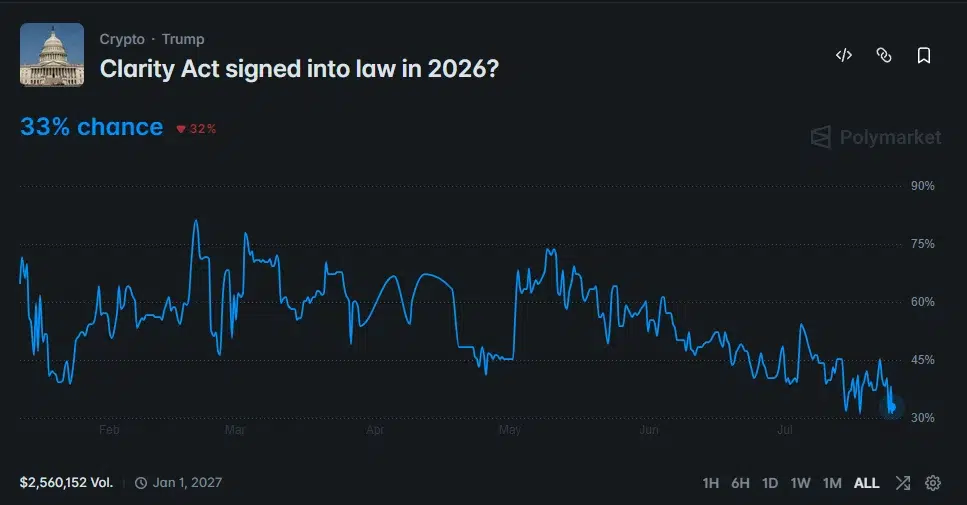
Polymarket’s chart shows that the odds climbed above 80% in late February before losing ground over the following months. The probability fell toward 30% in July as ethics disputes, banking opposition, and the approaching recess weakened confidence in passage.
Once lawmakers return after the elections, Hammond expects a narrow opportunity in which campaign pressure may ease enough to restart negotiations. Fortune reported that the effort would still compete with funding deadlines and defense legislation, leaving senators limited time to settle the remaining ethics, banking and enforcement disputes.