
Kalshi hit with temporary Michigan ban over sports event contracts


A Michigan court has temporarily barred Kalshi from offering sports event contracts to residents of the state, escalating the legal fight over federally regulated prediction markets.
- A Michigan judge has temporarily blocked Kalshi from offering sports event contracts to residents until July 13.
- The court ordered Kalshi to comply with geolocation rules or face fines of $120,000 for each day of noncompliance.
- Sports prediction trading continued to surge during the FIFA World Cup despite legal challenges against prediction market platforms.
According to a Monday court filing, Ingham County Circuit Court Judge Rosemarie Aquilina granted a temporary restraining order requiring Kalshi to stop offering sports event contracts to Michigan residents for 14 days, with the order set to expire on July 13.
The ruling also states that Kalshi could face a $120,000 daily fine if it fails to comply with the court’s geolocation requirements. In the order, Aquilina wrote that Michigan residents would suffer irreparable harm from being “exploited by Kalshi’s sports betting operation masquerading as an investment opportunity.”
The decision follows a lawsuit filed by Michigan Attorney General Dana Nessel in March, which argued that Kalshi’s sports event contracts violate the state’s Lawful Sports Betting Act by operating as unlicensed gambling products.
Earlier this month, a federal court sent the case back to Michigan state court after rejecting Kalshi’s attempt to move the dispute to the federal level.
Michigan joins states challenging prediction markets
With the latest order, Michigan has become the second state to secure a court ordered restriction on Kalshi’s sports event contracts after Nevada obtained a temporary injunction earlier this year. On June 17, Kentucky also sued Kalshi, Polymarket and several other prediction market platforms, alleging they were operating unlicensed sports betting businesses.
More than a dozen U.S. states have taken enforcement action against prediction market operators, while the U.S. Commodity Futures Trading Commission has challenged several of those efforts, arguing that federally regulated event contracts fall under its exclusive authority rather than state gambling laws.
The federal versus state jurisdiction dispute has continued to expand in recent weeks. On June 25, Kalshi filed a separate federal lawsuit challenging an Illinois law that would require prediction market platforms offering sports event contracts to obtain state licenses. In that complaint, the company argued that the Commodity Exchange Act gives the CFTC sole authority over its contracts and that individual states cannot impose separate licensing rules.
Legal filings from Kalshi have also argued that state level restrictions would force the company to build costly geofencing systems that could conflict with its obligation to operate a uniform national market under federal regulation.
World Cup drives prediction market activity
Even as legal disputes continue, sports-related trading has accelerated during the 2026 FIFA World Cup.
According to Dune data, Polymarket’s daily taker volume, which measures contracts purchased or sold by traders filling existing orders, reached a record $713 million on June 20, more than a week after the tournament began on June 11.
Simultaneously, data from analytics platform Defirate shows monthly sports prediction volume climbed 40% to $9.5 billion on Kalshi and 175% to $5.3 billion on Polymarket, making sports the largest category on both platforms during the tournament.
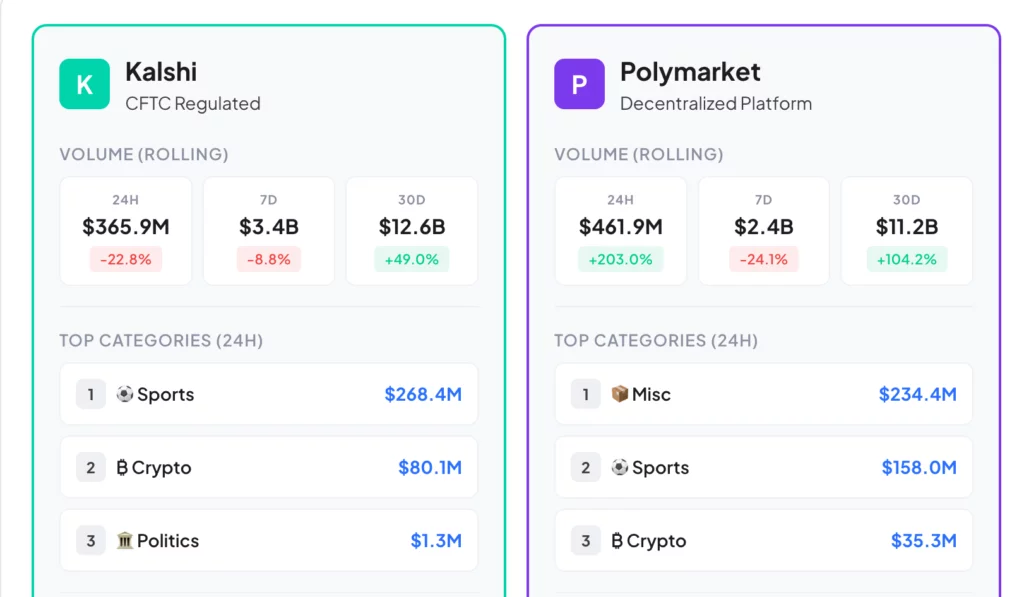
Source: Defirate.
A June 11 report from Bernstein estimated that the 2026 FIFA World Cup could generate more than $3 billion in additional sports betting handle and between $5 billion and $10 billion in new consumer prediction market volume.
Platform data also shows Polymarket’s World Cup winner contract has generated more than $3.5 billion in trading volume, highlighting the surge in activity despite the ongoing legal challenges facing prediction market operators.